
Comparing memory, Projects, context windows, and pricing across the three leading AI assistants — verified against official pricing pages and product documentation as of July 28, 2026.
If you're trying to decide which AI assistant can actually carry a project across weeks or months instead of forgetting everything between chats, the short answer is that none of the three does it cleanly, and each one fails in a different place.
Claude gives you the most durable project structure, unlimited Projects on its Pro plan, plus a memory system that now runs even on the free tier, but its working context inside the chat interface is capped at 200,000 tokens, regardless of plan.
ChatGPT offers the most mature combination of Projects and cross-conversation memory for non-technical users juggling several ongoing threads, though several of its most useful research and reasoning features are still rationed by monthly quotas even on paid tiers.
Gemini genuinely delivers a 1-million-token context window on its Google AI Pro plan, which makes it the strongest tool for digesting one enormous document in a single sitting, but its Gems (custom assistants) carry no memory between conversations, so it is the weakest of the three at picking up a project where you left it.
There is no universal winner here. The right tool depends on whether your "long-term project" means a large body of work you return to and build on over weeks, or a single very large input you need processed once.
This article breaks down what each platform actually does, verified against current pricing pages, product documentation, and recurring user reports, so you can match the tool to the job instead of the marketing claim.
Key Takeaways
Claude Pro ($17–$20/month) includes unlimited Projects and cross-conversation memory that also runs on the free plan, but Anthropic's own pricing page lists the chat context window at 200,000 tokens across Free, Pro, and Max, not the 1 million tokens some third-party guides advertise for the underlying model.
ChatGPT Plus ($20/month) pairs Projects with persistent memory and is the easiest of the three to live with day to day, but Deep Research and reasoning-mode usage are metered even on paid plans, and OpenAI's own comparison pages show non-reasoning context capped well below Claude's or Gemini's ceiling on business tiers.
Google AI Pro ($19.99/month) is the only plan of the three that reliably gives you a full 1-million-token context window for Gemini 3.1 Pro, but Gemini's Gems have no persistent memory, so continuity across sessions depends entirely on you re-supplying context.
A bigger context window number does not guarantee reliable use of that space. Google's own MRCR v2 long-context benchmark shows retrieval accuracy falling from roughly 84.9% at 128,000 tokens to about 26.3% at 1 million tokens, which matters more for long-term work than the headline figure.
If your work is mostly short, recurring tasks, all three platforms now offer some form of free memory or project organization, upgrade only once a specific limit (usage caps, file size, or missing Projects/Gems features) is actually blocking you, not before.
What a "long-term project" actually needs from an AI assistant
People use "long-term project" to describe two different problems, and the distinction matters more than any single benchmark.
Context window — how much text, code, or conversation history the model can hold and reason over inside a single exchange. This matters for feeding it a long contract, a full codebase, or a research archive in one go.
Persistent memory and project structure — what the assistant retains between separate sessions: your preferences, prior decisions, uploaded files, and the accumulated context of a project you touch a few times a week over months.
A tool can be strong on one axis and weak on the other. Gemini's context window is the largest of the three, but its Gems reset with every new chat. Claude's Projects and memory are the most consistent at holding a body of work together over time, but its own chat interface caps how much you can load into any single conversation.
Treating "long context" and "long-term memory" as the same feature is the most common mistake in how these tools get compared, and it is why raw benchmark numbers alone don't answer the reader's actual question.
Claude: the strongest project structure, a capped chat context
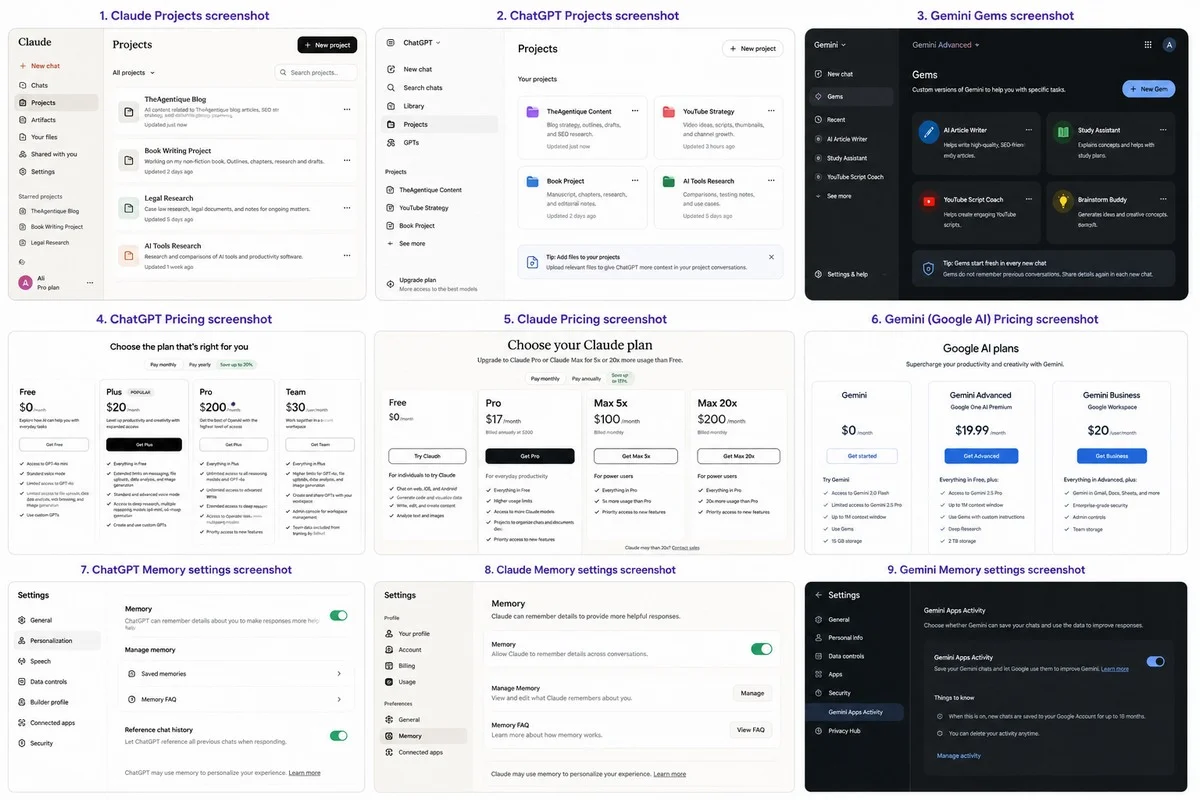
Anthropic's Claude is built around Projects, dedicated workspaces that hold files, custom instructions, and every chat related to one piece of work, and a memory system that, as of Anthropic's current pricing page, runs on every plan including the free tier. That combination is why Claude tends to be the recommendation for people managing a single complex project (a book manuscript, a legal matter, an ongoing codebase) rather than many small unrelated tasks.
| Plan | Price | Projects | Memory | Chat Context Window |
|---|---|---|---|---|
| Free | $0 | ✅ Available | Across conversations | 200,000 tokens |
| Pro | $17/mo (annual, billed $200 upfront) or $20/mo | ✅ Unlimited | Across conversations | 200,000 tokens |
| Max 5x / 20x | $100 or $200/mo | ✅ Unlimited (higher usage limits) | Across conversations | 200,000 tokens |
| Team (Standard / Premium) | $20 or $100 per seat annually ($25 / $125 monthly) | Shared, unlimited | Across conversations | 200,000 tokens |
| Enterprise | $20/seat + API-rate usage | Shared, unlimited | Across conversations | 500,000 tokens (default model) |
Table 1: Claude plan comparison. Source: claude.com/pricing, accessed July 28, 2026.
The catch is context size inside the standard chat interface. Anthropic's own plan-comparison table lists a 200,000-token context window for Free, Pro, and both Max tiers, with a larger 500,000-token window reserved for the default model on Enterprise plans. That is a meaningful correction against a number of third-party guides that describe a 1-million-token window as available broadly in chat, that ceiling exists for the underlying Sonnet 5 model via the API and inside Claude Code, but Anthropic does not currently list it for the consumer chat product.
In practice, 200,000 tokens is roughly 150,000 words, which comfortably covers most single documents but can still get tight on projects that accumulate dozens of long files and a lengthy chat history. For coding work specifically, Claude Code (included on every paid plan) is where the larger context and agentic workflows show up, which is one reason Claude's reputation for handling large codebases over time is stronger among developers than among people doing long-form writing purely in the chat window.
The most common complaint from recurring user reports is usage limits: Claude's five-hour rolling session limits, layered with weekly caps on paid plans, mean heavy users report hitting caps sooner than they expected, even on Pro. That is a real friction point for a genuinely long-running project where you might work for several hours at a stretch.
Who Claude fits: developers maintaining one codebase over months, writers and researchers managing a single dense project, and anyone who wants memory and Projects without paying more than $20 a month.
Who should skip it: anyone who regularly needs to load a single input larger than roughly 150,000 words into one chat, or teams that need Gemini- or ChatGPT-level breadth of consumer integrations (video generation, deep Workspace hooks) as part of the same subscription.
ChatGPT: the most complete "pick up where you left off" experience
OpenAI's ChatGPT was the first of the three to combine Projects with a genuine cross-chat memory system, and for non-technical users managing several small ongoing threads, a job search, a home renovation, a recurring content calendar, it remains the easiest to live with day to day. Custom GPTs, shared Projects on team plans, and a memory system OpenAI describes as "expanded" on Business and Enterprise plans all point at the same goal: don't make the user re-explain themselves.
| Plan | Price | Projects | Memory | Notable Limit |
|---|---|---|---|---|
| Free | $0 | ✅ Available | Basic | Lower-priority access and stricter usage caps |
| Go | $8/mo | ✅ Available | Basic | Does not include the flagship model |
| Plus | $20/mo | ✅ Available | Persistent | Deep Research is usage-limited (around 10/month, based on independent trackers) |
| Pro | $100 or $200/mo | ✅ Available | Persistent | Same models as Plus, with significantly higher usage limits |
| Business | $20/seat annually ($25 monthly), 2-seat minimum | Shared Projects | Expanded | 32K standard context / 196K reasoning context |
| Enterprise | Custom | Shared Projects | Expanded | Larger context window, custom retention, enterprise compliance |
Table 2: ChatGPT plan comparison. Sources: openai.com/business/chatgpt-pricing and chatgpt.com/pricing, accessed July 28, 2026; individual plan figures cross-checked against independent pricing trackers current to mid-July 2026.
The plan lineup has become the most complicated of the three. Beyond Free and the $20/month Plus plan, OpenAI now sells a $8/month Go tier that does not include the flagship model, and two separate Pro tiers at $100 and $200 that share the same model access but differ in usage headroom rather than capability, a structure that is easy to misread as a capability upgrade when it is really a usage upgrade. On the business side, OpenAI's own comparison table lists a 32,000-token non-reasoning context window and 196,000 tokens in reasoning mode for Business and Enterprise seats, both well short of Claude's or Gemini's advertised ceilings, though ChatGPT's reasoning models are designed to use that space more for internal deliberation than for holding raw source text.
Recurring feedback from long-time users, gathered across Reddit threads and independent testing roundups, converges on two things: ChatGPT's memory and general usability are strong, but its writing style is increasingly described as templated or overly cautious for professional work, and Deep Research is rationed even on paid plans, independent trackers report roughly ten Deep Research queries per month on Plus, which is a real constraint if your long-term project depends on repeated research passes rather than repeated writing sessions.
Who ChatGPT fits: people running several concurrent, moderately complex projects who value a consistent, low-friction interface over maximum context size, and teams already invested in OpenAI's broader app ecosystem (Slack, Google Drive, GitHub connectors on Business).
Who should skip it: anyone whose long-term project is fundamentally about processing very large individual documents, or who has been frustrated by ChatGPT's tendency toward generic phrasing on long-form professional writing.
Gemini: unmatched single-session context, weakest continuity
Google's Gemini is the clearest case of a platform optimizing for a different definition of "long." Google AI Pro, at $19.99 a month, gives Gemini 3.1 Pro a genuine 1-million-token context window, large enough to load an entire book, a full legal case file, or a sizable codebase into one conversation and query it directly.
| Plan | Price | Gems Memory | Context Window | Notable Feature |
|---|---|---|---|---|
| Free | $0 | ❌ None between chats | Standard (Gemini 3.5 Flash, limited Pro access) | Deep Research, Canvas, and Gems included |
| Google AI Plus | $4.99/mo | ❌ None between chats | Standard | 400 GB Google One storage |
| Google AI Pro | $19.99/mo | ❌ None between chats | 1,000,000 tokens (Gemini 3.1 Pro) | 20 Deep Research sessions/day, 5 TB Google One storage |
| Google AI Ultra | $99.99 or $199.99/mo | ❌ None between chats | 1,000,000 tokens | Deep Think reasoning mode with the highest usage limits |
Table 3: Google Gemini / Google AI plan comparison. Sources: Google AI pricing pages and independent trackers, accessed July 2026.
That number is real, but it comes with two caveats worth taking seriously. First, Google's own MRCR v2 benchmark, a published long-context retrieval test, shows accuracy dropping sharply as the input grows: roughly 84.9% at 128,000 tokens versus about 26.3% at the full 1-million-token mark. In practice this means the model can technically accept a million tokens without reliably using all of it well, so treating the ceiling as a guarantee of quality is a mistake regardless of provider, and Gemini's own data illustrates the point most starkly of the three.
Second, and more relevant to genuinely long-term work: Gemini's Gems, its equivalent of Claude's Projects or ChatGPT's custom GPTs, do not carry memory between chats. Independent hands-on testing comparing all three platforms' project features found that every new Gemini conversation starts from zero, with long conversations reportedly compressed by dropping content from the middle once they grow large enough, a pattern one reviewer described from direct testing rather than official documentation, so it should be read as a recurring observation rather than a confirmed specification. Either way, the practical effect is the same: Gemini rewards you for bringing a large amount of material into a single session, not for returning to a project across many sessions.
Where Gemini pulls ahead is ecosystem depth. Deep, native integration with Gmail, Docs, Sheets, and the wider Google Workspace makes it the pragmatic choice for anyone whose "project" already lives inside Google's tools, and the Google AI Pro plan bundles enough Google One cloud storage that it can offset the cost of a separate storage subscription for some users.
Who Gemini fits: anyone who needs to process one very large document or dataset in a single sitting, and anyone already deep inside Google Workspace who values integration over persistent memory.
Who should skip it: anyone whose project depends on the assistant remembering prior sessions without the user re-supplying context each time.
Side-by-side: trade-offs that matter for long-term work
| Criterion | Claude | ChatGPT | Gemini |
|---|---|---|---|
| Cross-session memory | ✅ Yes, on every plan (including Free) | ✅ Yes, persistent on Plus and above | ❌ No. Gems reset every session |
| Dedicated project workspace | Unlimited Projects (Pro+) | Projects on Plus+, shared on Business+ | Gems (no persistent memory) |
| Largest verified chat context | 200,000 tokens (consumer plans) | 196,000 reasoning / 32,000 standard (Business) | 1,000,000 tokens (Google AI Pro+) |
| Lowest price with memory + projects | Free | Free | $19.99/mo (1M-token tier; Gems still lack memory) |
| Most common limitation | Usage caps can be reached sooner during heavy workloads | Deep Research and reasoning-mode quotas even on paid plans | Reduced accuracy with very large contexts; no session-to-session continuity |
Table 4: Direct comparison on the criteria that matter for multi-week or multi-month projects. Figures reflect official pricing pages and product documentation as of July 28, 2026; usage-limit and long-context reliability figures are qualified where they come from independent testing rather than vendor specification.
Who should choose what
A developer or writer maintaining one project over months: Claude Pro. Unlimited Projects, memory that works out of the box, and Claude Code for anything code-heavy outweigh the 200,000-token chat ceiling for most single-project workflows.
Someone juggling several smaller ongoing threads (job search, errands, recurring content work): ChatGPT Plus. The combination of Projects, memory, and a generally more forgiving interface for non-technical use makes it the lowest-friction option, as long as you don't need heavy Deep Research volume.
Someone who needs to process one enormous document, codebase, or dataset occasionally and otherwise lives in Google Workspace: Google AI Pro. The 1-million-token window is real and useful for that specific job, even though it won't remember the project next week.
A team choosing a platform for compliance-sensitive or admin-heavy deployment: this decision usually turns on existing infrastructure (Microsoft 365 versus Google Workspace) and specific compliance requirements (HIPAA-readiness, SCIM, data residency) more than on any of the criteria above, check each vendor's Enterprise page directly, since those terms change independently of consumer pricing.
Someone doing occasional, low-stakes work: you likely don't need a paid plan at all. All three platforms now include some form of memory or Projects-equivalent structure on their free tiers; upgrade only once a specific, named limit, a usage cap, a missing feature, a file-size wall is actually stopping you.
The verdict
For most people asking which AI is best for long-term projects, Claude is the strongest default: it is the only one of the three built primarily around the idea that a project is a durable object you return to, not a conversation that resets. But "strongest default" is not "universal winner." If your long-term project is really a recurring set of smaller tasks, ChatGPT's memory and interface are more comfortable to live in day to day. If it's a single massive input you need to process well, Gemini's context window does something neither competitor currently matches in the consumer chat product.
The more durable lesson is that none of these platforms fully solves persistence. Even the best of the three still asks you to organize your own files, re-state your own priorities occasionally, and watch usage limits on paid plans. Pick based on the shape of your actual workflow, not the biggest number on the pricing page.
Sources & Further Reading
Claude Plans & Pricing — Anthropic (claude.com/pricing)
ChatGPT Pricing — OpenAI Business (openai.com/business/chatgpt-pricing)
Introducing ChatGPT Plus — OpenAI (openai.com/index/chatgpt-plus)

Leave a comment
Your email address will not be published. Required fields are marked *